LIBER LXXI
THE VOICE OF THE SILENCE
THE TWO PATHS
THE SEVEN PORTALS
BY
HELENA PETROVNA BLAVATSKY 8°=3°
WITH A COMMENTARY BY
FRATER O.M. 7°=4
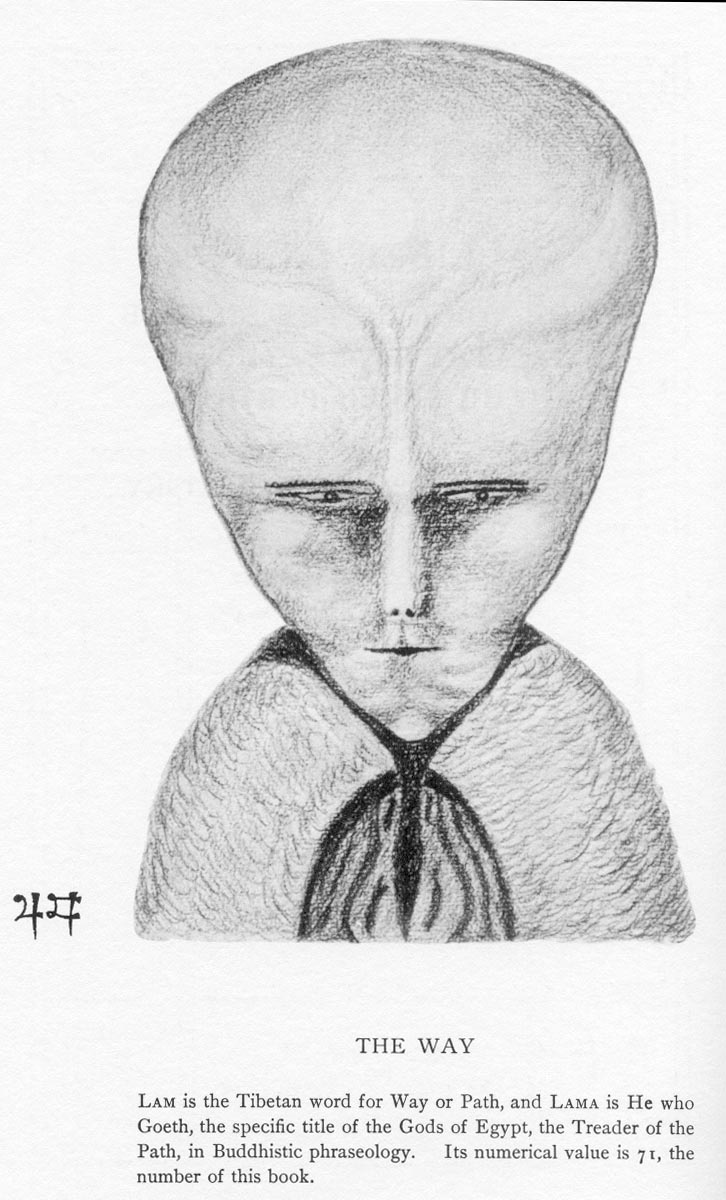
Figure 14. The
Way.
Lam is the Tibetan word for Way or Path, and Lama is He who
Goeth,
the specific title of the Gods of Egipt, the Treader of the Path,
in Buddhistic phraseology. Its numerical value is 71, the number
of
this book.
Prefatory Note
Do
what thou wilt shall be the whole of the Law.
I
T is NOT VERY DIFFICULT to write a book, if one chance to possess the
necessary degree of Initiation, and the power of expression. It is infernally
difficult to comment on such a Book. The principal reason for this is that
every statement is true and untrue, alternately, as one advances upon the Path
of the Wise. The question always arises: For what grade is this Book meant? To
give one simple concrete example, it is stated in the third part of this
treatise that Change is the great enemy. This is all very well as meaning that
one ought to stick to one’s job. But in another sense Change is the Great
Friend. As it is marvelous well shewed forth by The Beast Himself in Liber Aleph, Love is the law, and Love
is Change, by definition. Short of writing a separate interpretation suited
for every grade, therefore, the commentator is in a bog of quandary which
makes Flanders Mud seem like polished granite. He can only do his poor best,
leaving it very much to the intelligence of each reader to get just what he
needs. These remarks are peculiarly applicable to the present treatise; for
the issues are presented in so confused a manner that one almost wonders
whether Madame Blavatsky was not a reincarnation of the Woman with the Issue
of Blood familiar to readers of the Gospels. It is astonishing and distressing
to notice how the Lanoo, no matter what happens to him, soaring aloft like the
phang, and sailing gloriously
through innumerable Gates of High Initiation, nevertheless keeps his original
Point of View, like a Bourbon. He is always getting rid of Illusions, but,
like the entourage of the Cardinal Lord Archbishop of Rheims after he
cursed the thief, nobody seems one penny the worse—or the
better.
Probably
the best way to take the whole treatise is to assume that it is written for
the absolute tyro, with a good deal between the lines for the more advanced
mystic. This will excuse, to the mahatma-snob, a good deal of apparent
triviality and crudity of standpoint. It is of course necessary for the
commentator to point out just those things which the novice is not expected to
see. He will have to shew mysteries in many grades, and each reader must glean
his own wheat.
At
the same time, the commentator has done a good deal to uproot some of the
tares in the mind of the tyro aforesaid, which Madame Blavatsky was apparently
content to let grow until the day of judgment. But that day is come since she
wrote this Book; the New Æon is here, and its Word is Do what thou wilt. It is
certainly time to give the order: Chautauqua est
delenda.1
Love
is the law, love under will.
FRAGMENT
1
The
Voice of the Silence
1. These
instructions are for those ignorant of the dangers of the lower iddhi (magical
powers).
Do
what thou wilt shall be the whole of the Law. Nothing less can satisfy than
this Motion in your orbit.
It
is important to reject any iddhi of
which you may become possessed. Firstly, because of the wasting of energy,
which should rather be concentrated on further advance; and secondly, because
iddhi are in many cases so
seductive that they lead the unwary to forget altogether the real purpose of
their endeavours.
The
Student must be prepared for temptations of the most extraordinary subtlety;
as the Scriptures of the Christians mystically put it, in their queer but
often illuminating jargon, the Devil can disguise himself as an Angel of
Light.
A
species of parenthesis is necessary thus early in this Comment. One must warn
the reader that he is going to swim in very deep waters. To begin with, it is
assumed throughout that the student is already familiar with at least the
elements of Mysticism. True, you are supposed to be ignorant of the dangers of
the lower iddhi; but there are
really quite a lot of people, even
in
Boston, who do not know that there are any iddhi at all, low or high. However,
one who has been assiduous with Book 4, by Frater Perdurabo, should have no
difficulty so far as a general comprehension of the subject-matter of the Book
is concerned. Too ruddy a cheerfulness on the part of the assiduous one will
however be premature, to say the least. For the fact is that this treatise
does not contain an intelligible and coherent cosmogony. The unfortunate Lanoo
is in the position of a sea-captain who is furnished with the most elaborate
and detailed sailing-instructions, but is not allowed to have the
slightest idea of what port he is to make, still less given a chart of the
Ocean. One finds oneself accordingly in a sort of “Childe Roland to the Dark
Tower came” atmosphere. That poem of Browning owes much of its haunting charm
to this very circumstance, that the reader is never told who Childe Roland is,
or why he wants to get to the Dark Tower, or what he expects to find when he
does get there. There is a skilfully constructed atmosphere of Giants, and
Ogres, and Hunchbacks, and the rest of the apparatus of fairy-tales; but there
is no trace of the influence of Bædeker in the style. Now this is really very
irritating to anybody who happens to be seriously concerned to get to that
tower. I remember, as a boy, what misery 1 suffered over this poem. Had
Browning been alive, 1 think 1 would have sought him out, so seriously did 1
take the Quest. The student of Blavatsky is equally handicapped.
Fortunately, Book 4, Part III, comes to the rescue once more with a rough
sketch of the Universe as it is conceived by Those who know it; and a regular
investigation of that book, and the companion volumes ordered in “The
Curriculum of the A:. A:.,” fortified by steady persistence in practical
personal exploration, will enable this Voice of the Silence to become a
serious guide in some of the subtler obscurities which weigh upon the Eyelids
of the Seeker.
2. He who would hear the voice
of nãda, the
“Soundless
Sound,”
and comprehend it, he has to learn the nature
of
dhãranã.2
The
voice of nada is very soon heard by
the beginner, especially during the practice of pranayama (control of breath-force).
At first it resembles distant surf, though in the adept it is more like the
twittering of innumerable nightingales; but this sound is premonitory, as it
were, the veil of more distinct and articulate sounds which come later. It
corresponds in hearing to that dark veil which is seen when the eyes are
closed, although in this case a certain degree of progress is necessary before
anything at all is heard.
3. Having become indifferent
to objects of perception, the pupil must seek out the rãja’ of the senses, the
Thought-Producer, he who awakes illusion.
The
word “indifferent” here implies “able to shut out.” The Rajah referred to is
in that spot whence thoughts spring. He turns out ultimately to be Mayan, the
great Magician described in the 3rd Æthyr. 2 Let the Student notice that in
his early meditations, all his thoughts will be under the tamas-guna, the principle of
Inertia and Darkness. When he has destroyed all those, he will be under the
dominion of an entirely new set of the type of rajas-guna, the principle of Activity,
and so on. To the advanced Student a simple ordinary thought, which seems
little or nothing to the beginner, becomes a great and terrible fountain of
iniquity, and the higher he goes, up to a certain point, the point of
definitive victory, the more that is the case. The beginner can think, “it is
ten o’clock,” and dismiss the thought. To the mind of the adept this sentence
will awaken all its possible correspondences, all the reflections he has
ever made on time, as also accidental sympathetics like Mr. Whistler’s essay;
and if he is sufficiently far advanced, all these thoughts in their hundreds
and thousands diverging from the one thought, will again converge, and become
the resultant of all those thoughts. He will get samadhi upon that original thought,
and this will be a terrible enemy to his progress.
4. The Mind is the great
Slayer of the Real.
In
the word “Mind” we should include all phenomena of Mind, including samadhi itself. Any phenomenon has
causes and produces results, and al! these things are below the “REAL.” By the
REAL is here meant the nibbanadhatu.
5. Let
the Disciple slay the Slayer. For— This is a corollary of Verse 4. These texts
may be interpreted in a
quite
elementary sense. It is of course the object of even the beginner to suppress
mind and a!l its manifestations, but only as he advances will he discover what
Mind means.
6. When to himself his form
appears unreal, as do on
waking
all the forms he sees in dreams;
This
is a somewhat elementary result. Concentration on any subject leads soon
enough to a sudden and overwhelming conviction that the object is unreal.
The reason of this may perhaps be—speaking philosophically—that the object,
whatever it is, has only a relative existence.1
7. When he has ceased to hear
the many, he may discern the ONE —-the inner sound which kills the
outer.
By
the “many” are meant primarily noises which take place outside the Student,
and secondly, those which take place inside hmm.
For
example, the pulsation of the blood in the ears, and later the mystic sounds
which are described in Verse 40.
8. Then only, not till then,
shall he forsake the region of asat,
the false, to come unto the realm of sat, the true.
By
“sat, the true,” is meant a thing
previous to the “REAL” referred to above. Sat itself is an illusion. Some
schools of philosophy have a higher asat, Not-Being, which is beyond sat, and consequently is to šivadaršana as sat is to atmadaršana.2 Nirvana is
beyond both these.
9. Before the soul can see,
the Harmony within must be
attained,
and fleshly eyes be rendered blind to all illusion.
By the “Harmony within” is meant that state in which neither objects of sense, nor physiological sensations, nor emotions, can disturb the concentration of thought.
10. Before the Soul can hear, the image
(man) has to
become
as deaf to roarings as to whispers, to cries of
bellowing
elephants as to the silvery buzzing of the golden
fire-fly.
In
the text the image is explained as “Man,” but it more properly refers to
the consciousness of man, which consciousness is considered as being a
reflection of the Non-Ego, or a creation of the Ego, according to the school
of philosophy to which the Student may belong.
11. Before the soul can comprehend and may
remember, she must unto the Silent Speaker be united just as the form to which
the clay is modeled, is first united with the
potter’s
mind.
Any
actual object of the senses is considered as a precipitation of an ideal. Just
as no existing triangle is a pure triangle, since it must be either
equilateral, isosceles, or scalene, so every object is a miscarriage of an
ideal. In the course of practice one concentrates upon a given thing,
rejecting this outer appearance and arriving at that ideal, which of course
will not in any way resemble any of the objects which are its incarnations. It
is with this in view that the verse tells us that the Soul must be united to
the Silent Speaker. The words “Silent Speaker” may be considered as a
hieroglyph of the same character as Logos, Adonai or the Ineffable
Name.
12. For then the soul will hear and will
remember.
The
word “hear” alludes to the tradition that hearing is the organ of Spirit, just
as seeing is that of Fire. The word “remember” might be explained as “will
attain to memory.” Memory is the link between the atoms of consciousness, for
each successive consciousness of Man is a single phenomenon, and has no
connection with any other. A looking-glass knows nothing of the different
people that look into it. It only reflects one at a time. The brain is however
more like a sensitive plate, and memory is the faculty of bringing up into
consciousness any picture required. As this occurs in the normal man with his
own experiences, so it occurs in the Adept with al! experiences. (This is one
more reason for His identifying Himself with others.)
13. And then to the inner ear will speak—
THE VOICE OF THE SILENCE
And
say:— What follows must be regarded as the device of the poet, for
of
course
the “Voice of the Silence” cannot be interpreted in words. What follows is
only its utterance in respect of the Path itself.
14. If thy soul smiles while bathing in the
Sunlight of thy Life; if thy soul sings within her chrysalis of flesh and
matter; if thy soul weeps inside her castle of illusion; if thy soul struggles
to break the silver thread that binds her to the MASTER; know, O Disciple, thy
Soul is of the earth.
In
this verse the Student is exhorted to indifference to everything but his own
progress. It does not mean the indifference of the Man to the things around
him, as it has often been so unworthily and wickedly interpreted. The
indifference spoken of is a kind of inner indifference. Everything should be
enjoyed to the fu!!, but always with the reservation that the absence of the
thing enjoyed shall not cause regret. This is too hard for the beginner, and
in many cases it is necessary for him to abandon pleasures in order to prove
to himself that he is indifferent to them, and it may be occasionally
advisable even for the Adept to do this now and again. Of course during
periods of actual concentration there is no time whatever for anything but the
work itself; but to make even the mildest asceticism a rule of life is the
gravest of errors, except perhaps that of regarding Asceticism as a virtue.
This latter always leads to spiritual pride, and spiritual pride is the
principal quality of the brother of the Left-hand Path.
“Ascetic” comes from the Greek  “to work curiously, to adorn, to
exercise, to train.”The Latin ars
is derived from this same word. Artist, in its finest sense of creative
craftsman, is therefore the best translation. The word has degenerated under
Puntan foulness.
“to work curiously, to adorn, to
exercise, to train.”The Latin ars
is derived from this same word. Artist, in its finest sense of creative
craftsman, is therefore the best translation. The word has degenerated under
Puntan foulness.
15. When to the World’s turmoil thy budding soul lends ear; when to the roaring voice of the great illusion thy Soul responds; when frightened at the sight of the hot tears of pain, when deafened by the cries of distress, thy soul withdraws like the shy turtle within the carapace of
SELFHOOD,
learn, O Disciple, of her Silent “God,” thy Soul is an unworthy
shrine.
This
verse deals with an obstacle at a more advanced stage. It is again a warning
not to shut one’s self up in one’s own universe. It is not by the exclusion of
the Non-Ego that saintship is attained, but by its inclusion. Love is the law,
love under will.
16. When waxing stronger, thy Soul glides
forth from her secure retreat; and breaking bose from the protecting shrine,
extends her silver thread and rushes onward; when beholding her image on the
waves of Space she whispers, “This is I,” —declare, O Disciple, that thy Soul
is caught in the webs of delusion.
An
even more advanced instruction, but still connected with the question of the
Ego and the non-Ego. The phenomenon described is perhaps ãtmadaršana, which is still a
delusion, in one sense still a delusion of personality; for although the Ego
is destroyed in the Universe, and the Universe in it, there is a distinct
though exceedingly subtle tendency to sum up its experience as
Ego.
These
three verses might be interpreted also as quite elementary; y. 14 as
blindness to the First Noble Truth “Everything is Sorrow”; y. 15 as the
coward’s attempt to escape Sorrow by Retreat; and y. 16 as the acceptance of
the Astral as SAT.
17. This Earth, Disciple, is the Hall of Sorrow,
wherein are set along the Path of dire probations, traps to
ensnare
thy
EGO by the delusion called “Great Heresy.” Develops still further these
remarks.
18. This earth, O ignorant Disciple, is but the
dismal
entrance
leading to the twilight that precedes the valley of true light—that light
which no wind can extinguish, that light which burns without a wick or fuel.
“Twilight” here may again refer to ãtmadaršana. The last phrase is
borrowed from Eliphas Lévi, who
was not (I believe) a Tibetan of antiquity.2
19. Saith the Great Law:—”In order to
become the KNOWER of ALL-SELF, thou hast first
of
SELF to be the knower.” To reach the knowledge of that SELF, thou hast to give
up Self to Non-Self, Being to
Non-Being, and then thou canst repose between the wings of the GREAT BIRD.
Aye, sweet is rest between the wings of that which is not born, nor dies, but
is the AUM throughout eternal ages.
The
words “give up” may be explained as “yield” in its subtler or
quasi-masochistic erotic sense, but on a higher plane. In the following
quotation from the “Great Law” it explains that the yielding is not the
beginning but the end of the Path.
55. Then
let the End awake. Long hast thou
slept, O great God Terminus! Long ages hast
thou waited at the end of the city and the
roads thereof.
Awake Thou! wait no
more!
56. Nay, Lord! but I am come to
Thee. It is I
that wait at last.
57. The prophet cried against the
mountain;
come thou hither, that I may speak with
thee!
58. The mountain stirred not.
Therefore went
the prophet unto the mountain, and spake
unto it. But the feet of the prophet were
weary, and the mountain heard not his
voice.
59. But 1 have called unto Thee, and 1 have
jour
neyed unto Thee, and it availed me not.
60. b waited patiently, and Thou
wast with me
from the beginning.
61. This now I know, O my beloved, and we
are stretched at our ease among the vines.
62. But these thy prophets; they must cry
aloud and scourge themselves; they must cross trackless wastes and unfathomed
oceans; to await Thee is the end, not the beginning.’
Auth
is
here quoted as the hieroglyph of the Eternal. “A” the beginning of sound, “u” its middle, and “m” its end,
together form a single word or Trinity, indicating that the Real must be
regarded as of this three-fold nature, Birth, Life and Death, not successive,
but one. Those who have reached trances in which “time” is no more will
understand better than others how this rnay be.
20. Bestride the Bird of Life, if thou
would’st know.
The
word “know” is specially used here in a technical sense. Avidya, ignorance, the first of the
fetters, is moreover one which includes all the others.
With
regard to this Swan Auth compare
the following verses from the “Great Law,” “Liber LXV,”
11:17—25.
17. Also the Holy One came upon me, and I
beheld a white swan floating in the blue.
18. Between its wings I sate, and the æons
fled away.
19. Then the swan flew and dived and
soared, yet no whither we went.
20. A little crazy boy that rode with me
spake unto the swan, and said:
21. Who art thou that dost float and fly
and dive and soar in the inane? Behold, these many æons have passed; whence
camest thou? Whither wilt thou go?
22. And laughing ¡ child him, saying: No
whence! No whither!
23. The swan being silent, he answered:
Then, if with no goal, why this eternal journey?
24. And I laid my head against the Head of
the Swan, and laughed, saying: ¡s there not joy ineffable in this aimless
winging? Is there not weariness and impatience for who would attain to some
goal?
25. And the swan was ever silent. Ah! but
we floated in the infinite Abyss. Joy! Joy!
White
swan, bear thou ever me up
between
thy wings!
21. Give up thy life, if thou would’st
live.
This verse may be compared
with similar statements in the Gospels, in The Vision and the Voice, and in the
Books of It does not mean
asceticism in the sense usually understood by the world. The l2th Æthyr2
gives the clearest explanation of this phrase.
22.
Three Halls, O weary pilgrim, lead to the end of toils. Three Halls, O
conqueror of Mara, will bring thee
through three states into
the fourth and thence into the seven worlds, the worlds of Rest
Eternal.
If this had been a genuine
document I should have taken the three states to be sirotãpanna,3 etc., and
the fourth arhat, for which the reader should consult “Science and Buddhism”4
and similar treatises. But as it is better than “genuine,” being, like The
Chymical Marriage of Christian Rosencreutz, the forgery of a great adept, one
cannot too confidently refer it thus. For the “Seven Worlds” are not
Buddhism.
23. If
thou would’st learn their names, then hearken, and
remember.
The name of the first Hall
is IGNORANCE —avidyã. It is the Hall in which thou saw’s the light, in which
thou livest and shalt die.
These
three Halls correspond to the gunas:
Ignorance, tamas; Learning, rajas; Wisdom, sattva.
Again,
ignorance corresponds to Malkuth and Nephesch (the animal soul), Learning to
Tiphareth and Ruach (the mi), and Wisdom to Binah and Neschamah (the
aspiration or Divine Mind).
24. The name of Hall the second is the Hall
of LEARNING. in it thy Soul will find the blossoms of life, but under every
flower a serpent coiled.
This
Hall is a very much larger region than that usually understood by the
Astral World. It would certainly include alI states up to dhyãna. The Student will remember that
his “rewards” immediately transmute themselves into
temptations.
25. The
name of the third Hall is Wisdom, beyond which stretch the shoreless waters of
aksara,1 the indestructible Fount
of Omniscience.
Aksara
is
the same as the Great Sea of the Qabalah. The reader must consult The Equinox for a full study of this
Great Sea.2
26. If thou would’st cross the first Hall
safely, let not thy mind mistake the fires of lust that burn therein for the
Sunlight of life.
The
metaphor is now somewhat changed. The Hall of ignorance represents the
physical life. Note carefully the phraseology, “let not thy mind mistake the
fires of lust.” It is legitimate to warm yourself by those fires so long as
they do not deceive you.
27. If thou would’st cross the second
safely, stop not the fragrance of its stupefying blossoms to inhale. if freed
thou would’st be from the karmic
chains, seek not for thy guru
in those mãyãvic
regions.
A
similar lesson is taught in this verse. Do not imagine that your early psychic
experiences are Ultimate Truth. Do not become a slave to your
results.
28. The WISE ONES tarry not in
pleasure-grounds of senses.
This
lesson is confirmed. The wise ones tarry not. That is to say, they do not
allow pleasure to interfere with business.
29. The WISE ONES heed not the
sweet-tongued voices of illusion.
The
wise ones heed not. They listen to them, but do not necessarily attach
importance to what they say.
30. Seek for him who is to give thee birth,
in the Hall of Wisdom, the Hall which lies beyond, wherein all shadows are
unknown, and where the light of truth shines with unfading
glory.
This
apparently means that the only reliable guru is one who has attained the grade
of Magister Templi. For the attainments of this grade consult iber 418],
etc.1
31. That which is uncreate abides in thee,
Disciple, as it abides in that Hall. If thou would’st reach it and blend the
two, thou must divest thyself of thy dark garments of illusion. Stifle the
voice of flesh, albow no image of the senses to get between its light and
thine that thus the twain may blend in one. And having learnt thine own ajñãna2, flee from the Hall of
Learning. This Hall is dangerous in its perfidious beauty, is needed but for
thy probation. Beware, Lanoo, lest dazzled by illusive radiance thy Soul
should linger and be caught in its deceptive light.
This
is a résumé of the previous seven verses. It inculcates the necessity of
unwavering aspiration, and in particular warns the advanced Student against
accepting his rewards. There is ant method of meditation in which the Student
kills thoughts as they arise by the reflection, “That’s not it.” Frater P.
indicated the same by taking as his motto, in the Second Order which reaches
from Yesod to Chesed,1 “OT MH,” “No, certainly
not!”
32. This light shines from the jewel of the
Great Ensnarer, (Mãra). The senses it bewitches, blinds the mind, and leaves
the unwary an abandoned wreck.
1
am inclined to believe that most of Blavatsky’s notes are intended as blinds.
“Light” such as is described has a technical meaning. It would be too petty to
regard Mara as a Christian would regard a man who offered him a cigarette. The
supreme and blinding light of this jewel is the great vision of Light. It is
the light which streams from the threshold of nirvãna, and Mãra is the “dweller on
the threshold.” It is absurd to call this light “evil” in any commonplace
sense. It is the two-edged sword, flaming every way, that keeps the gate of
the Tree of Life. And there is a further Arcanum connected with this which it
would be improper here to divulge.
33. The moth attracted to the dazzling
flame of thy nightlamp is doomed to perish in the viscid oil. The unwary
Soul that fails to grapple with the mocking demon of illusion, will return to
earth the slave of Mára.
The
result of failing to reject rewards is the return to earth. The temptation is
to regard oneself as having attained, and so do no more
work.
34. Behold the Hosts of Souls. Watch how
they hover o’er the stormy sea of human life, and how exhausted, bleeding,
broken-winged, they drop one after other on the swelling waves. Tossed by the
fierce winds, chased by the gale, they drift into the eddies and disappear
within the first great vortex.
In
this metaphor is contained a warning against identifying the Soul with human
life, from the failure of its aspirations.
35. If
through the Hall of Wisdom, thou would’st reach the Vale of Bliss, Disciple,
close fast thy senses against the great dire heresy of separateness that weans
thee from the rest.
This
verse reads at first as if the heresy were still possible in the Hall of
Wisdom, but this is not as it seems. The Disciple is urged to find out his Ego
and slay it even in the beginning.
36. Let not thy “Heaven-born,” merged in
the sea of mäyã, break from the
Universal Parent (SOUL), but let the
fiery
power retire into the inmost chamber, the chamber of the Heart, and the abode
of the World’s Mother.
This
develops verse 35. The heaven-born
is the human consciousness. The chamber of the Heart is the anahata lotus. The abode of the
World’s Mother is the mulãdhãra
lotus. But there is a more technical meaning yet—and this whole verse
describes a particular method of meditation, a final method, which is far too
difflcult for the beginner.1
37. Then from the heart that Power shall
rise into the sixth, the middle region, the place between thin eyes, when it
becomes the breath of the ONE-SOUL, the voice which filleth all, thy Master’s
voice.
This
verse teaches the concentration of the kundalini in the ajñãcakra. “Breath” is that which
goes to and fro, and refers to the uniting of Šiva with Šakti in the sahasrara.2
38. ‘Tis only then thou canst become a
“Walker of the Sky” who treads the winds above the waves, whose
step
touches
not the waters.
This
partly refers to certain iddhi,
concerning Understanding of devas
(gods), etc.; here the word “wind” may be interpreted as “spirit.” It is
comparatively easy to reach this state, and it has no great importance. The
“walker of the sky” is much superior to the mere reader of the minds of
ants.
39. Before thou set’st thy foot upon the
ladder’s upper rung, the ladder of the mystic sounds, thou hast to hear the
voice of thy inner GOD in seven
manners.
The
word “seven” is here, as so frequently, rather poetic than mathematic; for
there are many more. The verse also reads as if it were necessary to hear all
the seven, and this is not the case— some will get one and some another. Some
students may even miss ah of them.1
40. The first is like the nightingale’s
sweet voice chanting a song of parting to its mate.
The
second comes as the sound of a silver cymbal of the dhyãnis, awakening the twinkling
stars.
The
next is as the plaint melodious of the ocean-sprite imprisoned in its
shell.
And
this is followed by the chant of vina
The
fifth like sound of bamboo-flute shrills in thine ear. It changes next into a
trumpet-blast.
The
last vibrates like the dull rumbling of a
thundercloud.
The
seventh swallows alt the other sounds. They die, and then are heard no
more.
The
first four are comparatively easy to obtain, and many people can hear them at
will. The last three are much rarer, not necessarily because they are
more difficult to get, and indicate greater advance, but because the
protective envelope of the Adept is become so strong that they cannot pierce
it. The last of the seven sometimes occurs, not as a sound, but as an
earthquake, if the expression may be permitted. It is a mingling of terror and
rapture impossible to describe, and as a general rule it completely discharges
the energy of the Adept, leaving him weaker than an attack of Malaria would
do; but if the practice has been right, this soon passes off, and the
experience has this advantage, that one is far hess troubled with minor
phenomena than before. It is just possible that this is referred to in the
Apocalypse XVI, XVII, XVIII.
41. When the six are slain and at the
Master’s feet are laid, then is the pupil merged into the ONE, becomes that o
N E and lives therein.
The
note tells that this refers to the six principles, so that the subject is
completely changed. By the slaying of the principles is meant the withdrawal
of the consciousness from them, their rejection by the seeker of truth.
Sabhapaty Swãmi has an excellent method on these unes;1 it is
given, in an improved form, in “Liber HHH.”2
42. Before that path is entered, thou must
destroy thy lunar body, cleanse thy mind-body and make clean thy
heart.
The
Lunar body is Nephesch, and the Mind body Ruach. The heart is Tiphareth, the
centre of Ruach.
43. Eternal life’s pure waters, clear and
crystal, with the monsoon tempest’s muddy torrents cannot
mingle.
We
are now again on the subject of suppressing thought. The pure water is the
stilled mind, the torrent the mind invaded by thoughts.
44. Heaven’s dew-drop glittering in the
morn’s first sunbeam within the bosom of the lotus, when dropped on earth
becomes a piece of clay; behold, the pearl is now a speck of
mire.
This
is not a mere poetic image. This dew-drop in the lotus is connected with the
mantra “aum mani padme hum,”3 and
to what this verse really refers is known only to members of the ninth degree
of O.T.O.
45. Strive
with thy thoughts unclean before they overpower thee. Use them as they will
thee, for if thou sparest them and they take root and grow, know well, these
thoughts will overpower and kill thee. Beware, Disciple,
suffer
not,
e’en though it be their shadow, to approach. For it will grow, increase in
size and power, and then this
thing
of darkness will absorb thy being before thou hast well realized the black
four monster’s presence.
The
text returns to the question of suppressing thoughts. Verse 44 has been
inserted where it is in the hope of deluding the reader into the belief that
it belongs to verses 43 and 45, for
the Arcanum which it contains is so dangerous that it must be guarded in alt
possible ways. Perhaps even to call attention to it is a blind intended to
prevent the reader from looking for something else.
46. Before the “mystic Power” can make of
thee a god, Lanoo, thou must have gained the faculty to slay thy lunar form at
will.
It
is now evident that by destroying or slaying is not meant a permanent
destruction. If you can slay a thing at will it means that you can revive it
at will, for the word “faculty” implies repeated action.
47. The Self of Matter and the Self of
Spirit can never
meet. One of the twain must disappear; there is no place for both.
This
is a very difficult verse, because
it appears so easy. It is not merely a question of Advaitism, it
refers to the spiritual marriage.1
48. Ere thy Soul’s mind can understand, the
bud of personality must be crushed out, the worm of sense destroyed past
resurrection.
This
is again filled with deeper meaning than that which appears on the surface.
The words “bud” and “worm” form a clue.
49. Thou canst not travel on the Path
before thou hast become that Path itself.
Compare
the scene in Parsifal, where the
scenery comes to the knight instead of the knight going to the scenery. But
there is also implied the doctrine of the tao, and only one who is an
accomplished Taoist can hope to understand this
verse.1
50. Let
thy Soul lend its ear to every cry of pain like as the lotus bares its heart
to drink the morning sun.
51. Let not the fierce sun dry one tear of
pain before thyself hast wiped it from the sufferer’s
eye.
52. But
let each burning human tear drop on thy heart and there remain; nor ever brush
it off, until the pain that caused it is removed.
This
is a counsel never to forget the original stimulus which has driven you to the
Path, the “first noble truth.” Everything is now “good.” This is why verse 53 says that these tears are the
streams that irrigate the fields of charity immortal. (Tears, by the way.
Think!)
53. These tears, O thou of heart most
merciful, these are
the
streams that irrigate the fields of charity immortal. ‘Tis on such soil that
grows the midnight blossom of Buddha, more difficult to find, more rare to
view than is the flowers of the vogay
tree. It is the seed of freedom from rebirth. It isolates the arhat both from strife and lust, it
leads him through the fields of Being unto the peace and bliss known only in
the land of Silence and Non-Being.
The
“midnight blossom” is a phrase connected with the doctrine of the Night of
Pan, familiar to Masters of the Temple. “The Poppy that flowers in the dusk”2
is another name for it. A most secret Formula of Magick is connected with this
“Heart of the Circle.”
54. Kill
out desire; but if thou killest it take heed lest from the dead it should
again rise.
By
“desire” in al! mystic treatises of any merit is meant tendency. Desire is
manifested universally in the law of gravitation, in that of chemical
attraction, and so on; in fact, everything that is done is caused by the
desire to do it, in this technical sense of the word. The “midnight blossom”
implies a certain monastic Renunciation of al! desire, which reaches to all
planes. One must however distinguish between desire, which means unnatural
attraction to an ideal, and love, which is natural
Motion.
55. Kill
love of life, but if thou slayest tanhã,1 let this not be for
thirst of life eternal, but to replace the fleeting by the
everlasting.
This
particularizes a special form of desire. The English is very obscure to any
one unacquainted with Buddhist literature. The “everlasting” referred to is
not a life-condition at all.
56. Desire
nothing. Chafe not at karma, nor at
Nature’s
changeless
laws. But struggle only with the personal, the transitory, the evanescent and
the perishable.
The
words “desire nothing” should be interpreted positively as well as negatively.
The main sense of the rest of the verse is to advise the Disciple to work, and
not to complain.
57. Help
Nature and work on with her; and Nature will
regard
thee as one of her creators and make obeisance.
Although
the object of the Disciple is to transcend Law, he must work through Law to
attain this end.
It
may be remarked that this treatise—and this comment for the most part—is
written for disciples of certain grades only. It is altogether inferior to
such Books as Liber CXI Aleph; but
for that very reason, more useful, perhaps, to the average seeker.
58. And she will open wide before thee the
portals of her secret chambers, lay bare before thy gaze the treasures hidden
in the depths of her pure virgin bosom. Unsullied by the hand of matter
she shows her treasures only to the eye of Spirit—the eye which never closes,
the eye for which there is no veil in all her kingdoms.
This
verse reminds one of the writings of Alchemists; and it should be interpreted
as the best of them would have interpreted
it.
59. Then
will she show thee the means and way, the first gate and the second, the
third, up to the very seventh. And then, the goal—beyond which he, bathed in
the sunlight of the Spirit, glories untold, unseen by any save the eye of
Soul.
These
gates are described in the third treatise. The words “spirit” and “soul” are
highly ambiguous, and had better be regarded as poetic figures, without a
technical meaning being sought.
60. There is but one road to the Path; at
its very end alone the “Voice of the Silence” can be heard. The ladder by
which the candidate ascends is formed of rungs of suffering and pain; these
can be silenced only by the voice of virtue. Woe, then, to thee, Disciple, if
there is one single vice thou hast not left behind. For then the ladder will
give way and overthrow thee; its foot rests in the deep mire of thy sins and
failings, and ere thou canst attempt to cross this wide abyss of matter thou
hast to lave thy feet in Waters of Renunciation. Beware lest thou should’st
set a foot still soiled upon the ladder’s lowest rung. Woe unto him who dares
pollute one rung with miry feet. The foul and viscous mud will dry, become
tenacious, then glue his feet unto the spot, and like a bird caught in the
wily fowler’s lime, he will be stayed from further progress. His vices will
take shape and drag him down. His sins will raise their voices like as the
jackal’s laugh and sob after the sun goes down; his thoughts become an army,
and bear him off a captive slave.
A
warning against any impurity in the original aspiration of the Disciple. By
impurity is meant, and should always be meant, the mingling (as opposed to the
combination) of two things. Do one thing at a time. This is particularly
necessary in the matter of the aspiration. For if the aspiration be in any way
impure, it means divergence in the will itself; and this is will’s one fatal
flaw. It will however be understood that aspiration constantly changes and
develops with progress. The beginner can only see a certain distance. Just so
with our first telescopes we discovered many new stars, and with each
improvement in the instrument we have discovered more. The second and more
obvious meaning in the verse preaches the practice of yama, niyama, before serious
practice is started, and this in actual hife means, map out your career
as well as you can. Decide to do so many hours’ work a day in such conditions
as may be possible. It does not mean that you should set up neuroses and
hysteria by suppressing your natural instincts, which are perfectly right on
their own plane, and only wrong when they invade other planes, and set up
alien tyrannies.
61. Kill thy desires, Lanoo, make thy vices impotent, ere the first step is taken on the solemn journey.
By
“desires” and “vices” are meant those things which you yourself think to
be inimical to the work; for each man they will be quite different, and any
attempt to lay down a general rule leads to worse than
confusion.
62. Strangle thy sins, and make them dumb
for ever, before thou dost lift one foot to mount the
ladder.
This
is merely a repetition of verse 61 in different language. But remember: “The
word of Sin is Restriction.” “Do what thou wilt shall be the whole of the
Law.”1
63. Silence thy thoughts and fix thy whole
attention on thy
Master
whom yet thou dost not see, but whom thou feelest.
This
again commands the stilling of thoughts. The previous verses referred rather
to emotions, which are the great stagnant pools on which the mosquito thought
breeds. Emotions are objectionable, as they represent an invasion of the
mental plane by sensory or moral impressions.
64. Merge into one sense thy senses, if
thou would’st be secure against the foe. ‘Tis by that sense alone which lies
concealed within the hollow of thy brain, that the steep path which leadeth to
thy Master may be disclosed before thy Soul’s dim eyes.
This
verse refers to a Meditation practice somewhat similar to those described in
“Liber 831.
65. Long and weary is the way before thee,
O Disciple. One single thought about the past that thou hast left behind, will
drag thee down and thou wilt have to start the climb
anew.
Remember
Lot’s wife.
66. Kill in thyself al! memory of past
experiences. Look not behind or thou art lost.
Remember
Lot’s wife.
It is a division of Will to
dwell in the past. But one’s past experiences must be built into one’s
Pyramid, as one advances, layer by layer. One must also remark that this verse
only applies to those who have not yet
come co reconcile past, present, and future.
Every incarnation is a Veil of Isis.
67. Do not believe that lust
can ever be killed out if gratified or satiated, for this is an
abomination inspired by Mãra. It is by feeding více that it expands and waxes
strong, like to the worm that fattens on the blossom’s
heart.
This verse must not be
taken in its literal sense. Hunger is not conquered by starvation. One’s
attitude to all the necessities which the traditions of earthly life involve
should be to rule them, neither by mortification nor by indulgence. In order
co do the work you must keep in proper physical and mental condition. Be
sane. Asceticism always excites the mind, and the object of the Disciple is to
calm it. However, ascetic originally meant athletic,
and it has only acquired its modern meaning on account of the corruptions that
crept into the practices used by those in “training.” The prohibitions,
relatively valuable, were exalted into general rules. To “break training” is
not a sin for anyone who is not in training. Incidentally, it takes all sorts
to make a world. Imagine the stupidity of a universe full of arhats! All work and no play makes
Jack a dull boy.
68. The rose must re-become the bud born of
its parent
stem,
before the parasite has eaten through its heart and drunk its
life-sap.
The
English is here ambiguous and obscure, but the meaning is that it is important
to achieve the Great Work while you have youth and
energy.
69. The golden tree puts forth its
jewel-buds before its trunk is withered by the storm.
Repeats
this in clearer language.
70. The Pupil must regain the child-state he has lost ere the
first sound can fall upon his ear.
Compare
the remark of “Christ,” “Except ye become as little children ye shall in no
wise enter into the Kingdom of Heaven,” and also, “Ye must be born again.”1 It
also refers to the overcoming of shame and of the sense of sin. If you
think the Temple of the Holy Ghost to be a pig-stye, it is certainly improper
to perform therein the Mass of the Graal. Therefore purify and consecrate
yourselves; and then, Kings and Priests unto God, perform ye the Miracle of
the One Substance.
Here
is written also the Mystery of Harpocrates. One must become the “Unconscious”
(of Jung), the Phallic or Divine Child or Dwarf-Self.
71. The light from the ONE Master, the one
unfading
golden
light of Spirit, shoots its effulgent beams on the disciple from the very
first. lts rays thread through the thick, dark clouds of
Matter.
The
Holy Guardian Angel is already aspiring to union with the Disciple, even
before his aspiration is formulated in the latter.
72. Now here, now there, these rays
illumine it, like sunsparks light the earth through the thick foliage of
jungle growth. But, O Disciple, unless the flesh is passive, head cool, the
soul as firm and pure as flaming diamond, the radiance will not reach the
chamber,
its
sunlight will not warm the heart, nor will the mystic sounds of ãkãsic heights reach the ear, however
eager, at the initial stage.
The
uniting of the Disciple with his Angel depends upon the former. The Latter is
always at hand. “Akašic
heights”—the dwelling-place of Nuit.
73. Unless thou hearest, thou canst not
see.
Unless
thou seest, thou canst not hear. To hear and see this is the second
stage.
……………………………………………………………………………………
This
is an obscure verse. It implies that the qualities of fire and Spirit
commingle to reach the second stage. There is evidently a verse missing, or
rather omitted, as may be understood by the row of dots; this presumably
refers to the third stage. This third stage may be found by the discerning in
“Liber 831.”
74. When the disciple sees and hears, and
when he smells and tastes, eyes closed, ears shut, with mouth and nostrils
stopped; when the four senses blend and ready are to pass into the fifth, that
of the inner touch—then into stage the fourth he hath passed
on.
The
practice indicated in verse 74 is described in most books upon the tatwas. The orifices of the face being
covered with the fingers, the senses take on a new
shape.
75. And
in the fifth, O slayer of thy thoughts, all these again have to be killed
beyond reanimation.
It
is not sufficient to get rid temporarily of one’s obstacles. One must seek out
their roots and destroy them, so that they can never rise again. This involves
a very deep psychological investigation, as a preliminary. But the whole
matter is one between the Self and its modifications, not at all between the
Instrument and its gates. To kill out the sense of sight is nor achieved by
removing the eyes. This mistake has done more to obscure the Path than any
other, and has been responsible for endless misery.
76. Withhold thy mind from ah external
objects, ah
external
sights. Withhold internal images, hest on thy Soul-light a dark shadow they
should cast.
This
is the usual instruction once more, but, going further, it intimates that
the internal image or reality of the object must be destroyed as well as the
outer image and the idea! image.
77. Thou art now in dhãranã,
the
sixth stage.
Dharana
has
been explained thoroughly in Book 4, q.v.1
78. When thou hast passed into the seventh,
O happy one, thou shall perceive no more the sacred three, for thou shalt have
become that three thyself. Thyself and mind, like twins upon a line, the star
which is thy goal, burns overhead. The three that dwell in glory and in bliss
ineffable, now in the world of mãyã have host their names. They have
become one star, the fire that burns but scorches not, that fire which is the
upãdhi2 of the
Flame.
It would be a mistake to attach more than a poetic meaning to these remarks upon the sacred Three; but Ego, non-Ego, and That which is formed from their wedding, are here referred to. There are two Triangles of especial importance to mystics; one is the equilateral, the other that familiar to the Past Master in Craft Masonry. The last sentence in the text refers to the “Seed” of Fire, the “Ace of Wands,” the “Lion-Serpent,” the “Dwarf-Self,” the “Winged Egg,” etc., etc., etc.
79. And this, O yogin of success, is what men cali dhyãna, the right precursor of samãdhi.
These
states have been sufficiently, and much better, described in Book 4, q.v.3
80. And now thy Self is lost in SELF, thyself unto THYSELF, merged in THAT
SELF from which thou first didst
radiate.
In
this verse is given a hint of the underlying philosophical theory of the
Cosmos. See Liber CXI for a full
and proper account of this.
81. Where is thy individuality, Lanoo,
where the Lanoo
himself?
It is the spark lost in the fire, the drop within the ocean, the ever-present
Ray become the ALL and the eternal radiance.
Again
principally poetical. The man is conceived as a mere accretion about his
“Dwarf-Self,” and he is now wholly absorbed therein. For IT is also ALL, being
of the Body of Nuit.
82. And now, Lanoo, thou art the doer and
the witness, the radiator and the radiation, Light in the Sound, and
the
Sound
in the Light.
Important,
as indicating the attainment of a mystical state, in which you are not only
involved in an action, but apart from it. There is a higher state described in
the Bhagavad-gtta. “I who am al!,
and made it al!, abide its separate Lord.”1
83. Thou art acquainted with the five
impediments, O
blessed
one. Thou art their conqueror, the Master of the sixth, deliverer of the four
modes of Truth. The Light that falls upon them shines from thyself, O thou who
wast Disciple but art Teacher now.
The
five impediments are usually taken to be the five senses. In this case the
term “Master of the sixth” becomes of profound significance. The “sixth sense”
is the race-instinct, whose common manifestation is in sex; this sense is then
the birth of the Individual or Conscious Self with the “Dwarf-Self,” the
Silent Babe, Harpocrates. The “four modes of Truth” (noble Truths) are
adequately described in “Science and Buddhism.”
|
84.
And
of these modes of
Truth:— |
Hast
thou not passed through knowledge of all misery—Truth the
first?
85. Hast
thou not conquered the Mãras’ King at Tsi, the portal of assembling—truth the
second?
86. Hast thou not sin at the third gate
destroyed and truth the third attained?
87. Hast thou not entered Tau, “the Path”
that leads to knowledge—the fourth truth?
The
reference to the “Mãras’ King” confuses the second truth with the third. The
third Truth is a mere corollary of the Second, and the Fourth a Grammar of the
Third.
88. And now, rest ‘neath the bodhi tree, which is perfection of a!!
knowledge, for, know, thou art the Master of samãdhi—the state of faultless
vision.
This
account of samadhi is very
incongruous. Throughout the whole treatise Hindu ideas are painfully mixed
with Buddhist, and the introduction of the “four noble truths” comes very
strangely as the precursor of verses 88 and 89.
89. Behold! thou hast become the light,
thou hast become the Sound, thou art thy Master and thy God. Thou art THYSELF
the object of thy search: the VOICE unbroken, that resounds throughout
eternities, exempt from change, from sin exempt, the seven sounds in one,
the
VOICE
OF THE SILENCE
Auth
Tat Sat.
This
is a pure peroration, and clearly involves an egocentric
metaphysic.
The
style of the whole treatise is characteristically
occidental.